 Aethelgard Press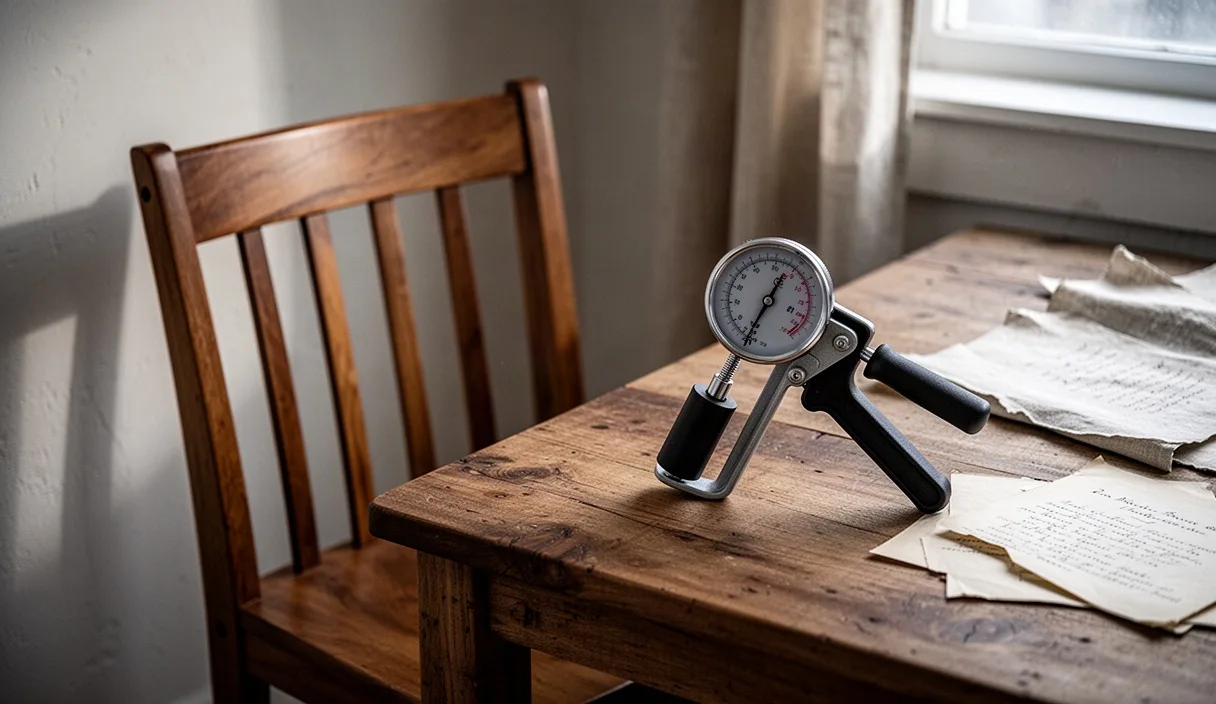
Functional strength serves as an unvarnished mirror of biological aging. While cardiovascular metrics like resting heart rate and VO2 max command significant attention, muscular output provides an equally distinct signal of systemic vitality. Two straightforward field assessments, the handgrip dynamometer test and the thirty-second chair stand test, isolate neuromuscular capacity, joint integrity, and motor control without requiring an exercise physiology laboratory. Tracking these numbers grants direct insight into the functional reserve that protects independence as decades advance.
Neither test measures vanity metrics. Instead, they quantify baseline survival architecture. The force your hand exerts against an isometric handle reflects overall skeletal muscle mass, peripheral nerve health, and cellular energetics. Simultaneously, your capacity to repeatedly raise your body mass against gravity using knee and hip extensors isolates the mechanical power that prevents catastrophic falls. When assessed systematically, these tools strip away guesswork, producing actionable, repeatable data that highlights neuromuscular degradation long before mobility loss impairs daily life.
The Clinical Significance of Grip Strength in Longevity Research
Epidemiological researchers frequently describe handgrip strength as a biological biomarker of aging rather than merely a localized forearm measurement. The landmark Prospective Urban Rural Epidemiology (PURE) study, tracking nearly 140,000 adults across 17 countries, discovered that every 5-kilogram decline in grip force correlated with a 16-percent increased risk of all-cause mortality. It proved to be a stronger predictor of cardiovascular death than systolic blood pressure, an established standard in preventive cardiology.
The biological mechanism linking handgrip to broad health outcomes rests upon the shared environment of systemic tissue. Force production requires intact motor unit recruitment from the central nervous system, rapid signal transmission through myelin sheaths, functional excitation-contraction coupling within muscle fibers, and adequate cellular adenosine triphosphate (ATP) production via healthy mitochondria. Chronic systemic inflammation, excessive circulating catabolic cytokines, and insulin resistance blunt this neuromuscular chain. A weak grip is rarely isolated to the hands; it points to diffuse neuromuscular deterioration across the organism.
Beyond general mortality, low baseline grip numbers predict poor outcomes following elective surgeries, longer hospital stays, and increased vulnerability to hospital-acquired complications. When an individual suffers acute physiological trauma, such as an infection or bone fracture, the body draws heavily on amino acid reserves stored in skeletal muscle to fuel immune response and tissue repair. Individuals with depleted functional reserve slide past the threshold of functional dependency under stress, while those with higher reserves weather identical metabolic shocks with preserved baseline function.
Protocol for the Thirty-Second Chair Stand Test
The thirty-second chair stand test, developed by researchers at California State University, Fullerton, isolates lower-body functional power, dynamic balance, and localized muscular endurance. Administering this test requires strict adherence to standardized parameters. Altering chair dimensions or technique invalidates the score against published epidemiological baselines.
Use a sturdy, armless chair with a flat, rigid seat positioned at a height of 43 centimeters (approximately 17 inches) from the floor. Place the chair securely against a solid wall to prevent backward movement during aggressive efforts. The floor surface must be level and slip-resistant. Wear flat-soled athletic footwear; running shoes with thick, compressible foam soles destabilize the base and bleed mechanical force during ground drive.
Execute the assessment using the following verified sequence:
- Seated preparation: Sit upright in the center of the seat, spine neutral, with feet flat on the floor spaced approximately shoulder-width apart. Fold your arms across your chest, resting each hand flat on the opposite shoulder. These arms must remain pinned to the torso throughout the entire duration.
- Initiation: Start a precise thirty-second stopwatch on the command to move. Immediately drive through the midfoot and heel to reach a complete standing posture.
- Extension check: Stand fully active vitality. Hips and knees must achieve full anatomical extension at the top of each repetition. Pausing short of lockout eliminates the repetition from your official tally.
- Descent: Lower the body under control until the gluteal muscles make contact with the chair seat. You do not need to rest your weight backward, but your hips must firmly touch the bench before the next repetition begins. Bouncing off the surface using structural spring is prohibited.
- Scoring completion: Count the total number of full, valid repetitions executed within thirty seconds. If a repetition is halfway complete when the timer sounds, count it as a full repetition. If it has not reached the halfway mark, discard it.
Selecting and Calibrating a Hand Dynamometer
Reliable data demands precision instruments. Handheld dynamometers fall into two broad designs: hydraulic systems and electronic load-cell sensors. The gold standard across clinical and academic literature remains the Jamar hydraulic dynamometer, or precise mechanical analogues like the Baseline hydraulic unit. These devices operate on a closed fluid system where manual compression displaces hydraulic fluid to push an indicator needle across a dual-scale gauge.
Electronic digital dynamometers, such as the widely available Camry models, cost significantly less and offer auto-averaging features, yet they introduce mechanical vulnerabilities. Digital load cells can exhibit drift after sustained high-force efforts and often feature plastic structural components that flex under load, dampening the recorded force output. For continuous tracking, a certified hydraulic unit or an independently validated medical-grade digital dynamometer guarantees consistency across years of testing.
Physical calibration prevents systematic drift. Hydraulic dynamometers must be inspected quarterly for zero-point alignment: the needle must rest precisely at zero without fluid leakage in the casing. Manufacturers recommend annual factory calibration using certified dead weights suspended from the center of the handle to verify linearity across 10-kilogram increments up to 90 kilograms. If a unit experiences a drop onto a hard floor, treat its readouts as uncalibrated until recertified.
To record accurate numbers, set the handle position correctly. Hydraulic units feature five distinct notch settings. Adjust the handle so the middle phalanx of your index finger rests squarely at a 90-degree angle against the inner bar. Stand or sit upright, pin your elbow to your torso at a strict 90-degree angle, maintain a neutral wrist, and squeeze the handle with maximal, explosive effort for three continuous seconds. Record three trials per hand, allowing sixty seconds of complete rest between efforts, and use the peak value for your records.
Interpreting Your Numbers Against Validated Cohort Data
Raw numbers acquire utility only when positioned within validated population distributions. Handgrip strength peaks mechanically between ages 25 and 35, followed by a gradual decline of approximately 1 percent per year, accelerating past age 60. The chair stand test demonstrates a parallel downward trajectory driven by selective type II fast-twitch muscle fiber atrophy.
The European Working Group on Sarcopenia in Older People (EWGSOP2) establishes diagnostic thresholds for clinical weakness. For men, a peak grip strength below 27 kilograms marks the boundary for suspected sarcopenia. For women, the diagnostic cutoff sits at 16 kilograms. Falling below these thresholds correlates with elevated risks of functional dependency, loss of ambulatory speed, and institutionalization.
The following performance tables reflect normative median values derived from broad cross-sectional cohort studies of community-dwelling adults.
| Metric and Age Bracket | Below Average | Functional Baseline | Robust / High Reserve |
|---|---|---|---|
| Male Grip (Age 40-49) | Under 44 kg | 45 - 54 kg | Over 55 kg |
| Male Grip (Age 50-59) | Under 40 kg | 41 - 50 kg | Over 51 kg |
| Male Grip (Age 60-69) | Under 34 kg | 35 - 44 kg | Over 45 kg |
| Male Grip (Age 70+) | Under 28 kg | 29 - 37 kg | Over 38 kg |
| Female Grip (Age 40-49) | Under 26 kg | 27 - 34 kg | Over 35 kg |
| Female Grip (Age 50-59) | Under 23 kg | 24 - 31 kg | Over 32 kg |
| Female Grip (Age 60-69) | Under 20 kg | 21 - 27 kg | Over 28 kg |
| Female Grip (Age 70+) | Under 17 kg | 18 - 24 kg | Over 25 kg |
| Chair Stand: Men (Age 60-69) | Under 12 reps | 14 - 18 reps | Over 19 reps |
| Chair Stand: Women (Age 60-69) | Under 11 reps | 13 - 17 reps | Over 18 reps |
| Chair Stand: Men (Age 70-79) | Under 10 reps | 12 - 16 reps | Over 17 reps |
| Chair Stand: Women (Age 70-79) | Under 10 reps | 11 - 15 reps | Over 16 reps |
If your results position you in the below-average tier, that placement represents an actionable early warning rather than an unalterable trajectory. It identifies an immediate need to interrupt neuromuscular atrophy through progressive resistance exercise. If you record numbers in the robust tier, your objective shifts toward preserving that functional buffer through consistent metabolic and mechanical loading.
Basic Loading Exercises to Rebuild Foundational Strength
Reversing downward trends in these biomarkers requires targeted, progressive overload focused on the kinetic chains tested. Isolated wrist curls or seated leg extensions provide suboptimal returns compared to compound movements that demand integrated stability and heavy neurological drive.
Loaded Carries (Farmer Walks)
Loaded carries build unyielding crushing grip, static wrist stabilization, and scapular endurance simultaneously. Select two kettlebells or dumbbells weighing roughly 20 to 25 percent of your body mass per hand. Stand tall, brace your abdominal wall, pin your shoulder blades slightly back and down, and walk in a deliberate heel-to-toe pattern for 30 to 45 seconds. Keep your hands off your thighs. Complete three to four sets, resting two minutes between rounds. As grip capacity expands, increase weight while keeping transit time constant.
Dead Hangs from an Overhead Bar
Dead hangs challenge passive grip endurance, activate the rotator cuff, and decompress the lumbar spine. Grasp a rigid pull-up bar using an overhand (pronated) grip with hands shoulder-width apart. Step off the support, allowing your full weight to load the hands and shoulders. Avoid relaxing into an excessive passive shrug; maintain minimal muscular tension around the shoulder blades to protect the glenohumeral joint. Strive for accumulated volume: three rounds of 20 to 40 seconds. Progress toward single-arm holds or active weighted hangs as capacity builds.
Box Squats and Goblet Squats
To rebuild the power measured by the chair stand, train the exact biomechanical pattern under increased load. Stand before a bench or box set to a height where your thighs hit parallel. Hold a dumbbell or kettlebell vertically against your sternum with both hands. Initiate the squat by unlocking the hips backward while spreading your knees apart to track over the toes. Descend under a three-second control until your hips rest gently on the box without relaxing your torso. Pause for one second, then explode upward to full hip and knee lockout. Perform three sets of 8 to 12 clean repetitions twice weekly.
Tempo Step-Ups
The thirty-second chair stand exposes single-limb asymmetries that bilateral squats can mask. Utilize an 8-to-12-inch stable wooden box. Place the entire sole of one foot flat on the surface. Drive exclusively through that elevated leg to stand active vitality on the platform, touching the trailing foot down lightly without pushing off with the lower toes. Lower your trailing foot to the floor over a controlled three-second count. Perform three sets of 8 to 10 repetitions per leg. This movement strengthens the vastus medialis, gluteus medius, and stabilizes ankle mechanics under load.
Common Assessment Mistakes
Flawed measurement execution produces skewed data that either masks critical decline or fabricates false progress. When running these functional screens, systematically avoid the following operational errors:
- Momentum generation during chair rises: Leaning the upper torso forward aggressively and whipping the chest backward converts leg power into mechanical momentum. Keep your back straight, hinge slightly at the hip, and drive upward solely via the quads and glutes.
- Incorrect dynamometer handle setting: Testing grip with the handle set too wide or too narrow reduces force transfer by up to 20 percent. Always position the inner bar flush against the middle phalanx of your flexed fingers.
- Upper limb body contact: Resting your testing elbow against your ribcage or thigh allows the torso to stabilize the dynamometer, artificially inflating grip scores. Keep your elbow bent at 90 degrees, suspended cleanly off your torso.
- Incomplete joint extension: Failing to lock the hips and knees at the top of the chair stand masks quadriceps deficits and yields an artificially inflated repetition count.
- Fatigue contamination: Attempting dynamometer maximal efforts immediately after a heavy upper-body gym session records peripheral muscle exhaustion, not your true functional capacity. Test consistently after a rest day or before physical training begins.
Practical Next Steps for Long-Term Tracking
Establish a regular testing cadence to turn raw data into a reliable longitudinal record. Execute both tests once every twelve weeks under identical environmental parameters. Record your scores in a dedicated physical log or spreadsheet, tracking baseline time of day, sleep conditions, and current body weight alongside raw numbers. Testing more frequently introduces neural learning effects rather than true morphological adaptation.
Treat downward shifts with pragmatic urgency. A confirmed decline of 10 percent or greater across two consecutive quarters signals accelerating muscular atrophy, insufficient dietary protein intake, or insidious underlying inflammation. If you note significant unexplained weakness, unilateral discrepancy where one side drops precipitously, or sudden coordination loss, consult an exercise physiologist or a physician for a comprehensive neuromuscular workup. Use these assessments as reliable yardsticks to measure your mechanical capacity, making systematic strength training a mandatory component of your lifestyle.